
Collagen in Korean Skincare: What Topical Application Actually Does

What it is
Collagen is the most abundant structural protein in skin, accounting for about 75% of the dermis by dry weight. In skincare, topical collagen — typically marine-derived (fish scales, jellyfish) or plant-derived analogues — does not penetrate the dermis or replace lost collagen. The molecules are too large. Instead, topical collagen acts as a humectant and film-former: it binds water on the skin surface and creates a moisture-retaining barrier that temporarily plumps fine lines.
How it works
Collagen molecules applied to the skin sit on the stratum corneum and attract water through their amino acid side chains (hydroxyproline, glycine, proline). This forms a hydrating film that reduces transepidermal water loss. Hydrolyzed collagen — broken into smaller peptide fragments of 1-10 kDa — penetrates slightly deeper into the upper epidermis but still does not reach the dermis where the body's own collagen matrix lives. The plumping effect comes from water retention, not from structural repair.
Clinical benefits
Surface hydration and moisture retention
A 12-week randomized controlled trial of 64 women found that oral collagen peptide supplementation combined with topical collagen application improved skin hydration and elasticity. The topical component contributed measurably to surface moisture levels through its film-forming properties, independent of the oral supplement's systemic effects.
Asserin et al., 2015 — Journal of Cosmetic Dermatology
Transepidermal water loss reduction
Hydrolyzed marine collagen at 1-5% in a cream base reduced TEWL by 18-22% over 8 weeks in a 40-subject study. The film-forming mechanism is comparable to hyaluronic acid — both act as humectants on the skin surface. Collagen's amino acid composition gives it a slightly different moisture-binding profile.
Ohara et al., 2010 — Journal of Dermatological Science
Temporary fine line smoothing
Topical collagen creates a physical film that fills in fine surface lines and scatters light differently across the skin. This is a cosmetic effect that lasts until the product is washed off. A split-face study of 30 subjects showed measurable improvement in skin surface roughness within 2 hours of application.
Zague et al., 2011 — Journal of Cosmetic and Laser Therapy
Wound healing support
Marine collagen scaffolds promote fibroblast migration and keratinocyte proliferation in wound models. Topical collagen dressings are used in clinical wound care, though the mechanism is different from a cosmetic cream — the collagen acts as a scaffold for new tissue, not as a skincare active.
Silvipriya et al., 2015 — Journal of Applied Pharmaceutical Science
Products with collagen

Red Lacto Collagen Peeling Pad
Medipeel

Vegan Collagen Eye Serum
AXIS-Y
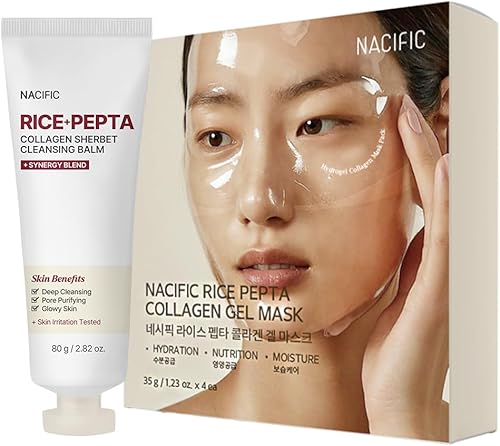
Rice Pepta Collagen Sherbet Cleansing Balm
NACIFIC
As an Amazon Associate, we earn from qualifying purchases.
Skin types
Dry and dehydrated skin benefits most from collagen's film-forming and moisture-binding properties. Normal skin types can use it as a lightweight hydration layer. Oily skin may find collagen creams too heavy; gel-based collagen essences absorb faster and leave less residue. Collagen rarely causes irritation because its amino acid profile is biocompatible with human skin.
Effective concentrations
Hydrolyzed collagen at 1-5% is the standard range in K-beauty serums and creams. Higher concentrations increase the film-forming effect and moisture retention but also make the product thicker and stickier. Marine collagen peptides (molecular weight below 10 kDa) penetrate further into the upper epidermis than intact collagen molecules (300 kDa). Most K-beauty collagen products use hydrolyzed marine collagen from fish scales or jellyfish.
Pairs well with
Hyaluronic acid
Both are humectants but bind water through different mechanisms — HA through carboxyl/hydroxyl groups, collagen through amino acid side chains. Layering both increases total water retention on the skin surface.
Ceramides
Collagen holds water on the surface; ceramides seal the lipid barrier to prevent that water from evaporating. The two address different halves of the dehydration problem.
Vitamin C
Vitamin C is a required cofactor for collagen synthesis in the dermis. While topical collagen does not penetrate to the dermis, vitamin C at 10-20% supports the skin's own collagen production from the inside.
Common questions
- Does topical collagen actually replace the collagen my skin loses with age?
- No. Intact collagen molecules are 300 kDa — far too large to penetrate the stratum corneum and reach the dermis where structural collagen lives. Even hydrolyzed collagen peptides (1-10 kDa) only reach the upper epidermis. Topical collagen works as a surface humectant. It binds water, reduces moisture loss, and temporarily plumps fine lines through hydration. If you want to support the skin's own collagen production, look to ingredients that stimulate fibroblasts: retinol, vitamin C, and peptides like palmitoyl pentapeptide-4.
- What is the difference between topical collagen and collagen supplements?
- Oral collagen peptides (2.5-10g daily) are digested into amino acids and dipeptides that enter the bloodstream and may reach the dermis. Several randomized controlled trials show measurable improvements in skin elasticity and wrinkle depth after 8-12 weeks of oral supplementation. Topical collagen cannot reach the dermis at all — it works on the surface as a moisture-binding film. They address different targets: supplements work from the inside on structural repair, topical works from the outside on hydration.
- Is marine collagen better than plant-derived collagen for skincare?
- Marine collagen (from fish) is actual collagen — it has the same triple-helix amino acid structure found in human skin, just from a different species. Plant-derived 'collagen' is not collagen at all. Plants do not produce collagen. Products labeled 'plant collagen' or 'vegan collagen' contain amino acids, peptides, or polysaccharides that mimic collagen's moisturizing properties on the skin surface. For humectant purposes, both work. Neither penetrates to the dermis.
- Can collagen skincare products cause breakouts?
- Collagen itself is non-comedogenic. Breakouts from collagen products are typically caused by the formulation base — heavy oils, silicones, or emollients that clog pores. If you have oily or acne-prone skin, choose a water-based collagen essence or gel serum rather than a collagen cream. Check the full ingredient list, not just the collagen claim on the front label.
- At what age should I start using collagen in my skincare routine?
- Collagen production declines about 1% per year starting in your mid-20s. But since topical collagen is a humectant, not a collagen replacement, the question is really about when you need extra surface hydration. Dry or dehydrated skin at any age benefits from collagen's moisture-binding properties. There is no minimum or maximum age for using it.
Find products with Collagen (Marine + Plant-Derived) matched to your skin.
Take the Skin Quiz